Showing posts with label interview. Show all posts

24.9.08

All I Know: living on borrowed time


Hardcorekids seem to end up in the most diverse musical genres. If it's not hiphop (the Beastie Boys), it could be melancholic singer-songwriter-stuff (Elliott Smith), or nerdy electronic music (Moby). But 80's classic rock? That might be stretching it a bit. Not for the guys and girl in All I Know though. Starting out as a regular poppunk band and releasing two more than decent demo's over the course of the last two years, they now show themselves ready for the big world with the release of their debutalbum 'Vanity Kills'.

Released by themselves out of impatience, the album is a treat to anyone with an ear for catchy hooks and poppy melodies, in short, for anyone who likes his music 'big' and instant-stadiumtour-ready. The band at this point consists of Amely Mondy (bass), Michaël Neyt (guitar and vocals), Ward Dufraimont (guitar and vocals) and latest member Dries Van Dyck (drum). Michaël, Ward and Dries are all ex-member of more or less famous Belgian hardcorebands, such as Liar, Firestone, Convict and Bloodshed. 
During the recording of the album, while the band was locked up in a notorious studio in the centre of Brussels for several months, they managed to ensnare the cream of the crop of Belgian popmusicians to play along on some songs, thus showing a band more confident than ever of its own work. The time was right to ask main songwriter and founding member Ward Dufraimont (26) some questions about Bon Jovi, pissing people off and veganism.

First off, what inspired you to start All I Know at the time, when you were still playing with Liar?
Dufraimont: "I had been playing in metalcore bands for yeas. I needed a way to get some other musical influences off my chest. It kinda started as a thing on the side, we probably rehearsed for close to two years without ever thinking about playing shows or whatnot. It was just something I enjoyed doing with friens, it didn't get 'serious' until the Liar thing had run its course."

AIK used to be more of a poppunkband a couple of years ago, but with 'Vanity Kills' you seem to have changed styles pretty drastically. Is this the kind of music you wanted to make with the band all along, or is it something that just came naturally?
"None of us follow the whole poppunk thing anymore. We wanted our first full length album to be something that represented what we ourselves would enjoy listening to. Everyone in AIK is very much into classic melodic rock, with big choruses, big hooks, big everything. The first few songs we wrote for the album were pretty much in the vein of our previous work. Early on though, we noticed we weren't enjoying it as much as we used to. The only solution was to just go with what came naturally, instead of desperately trying to write what people expected from us. It's not like we look down on the poppunk thing now though. It's just that there's so many bands out there doing that, and some of them are doing a way better job than we ever did. AIK as a band decided that we were going to do whatever we wanted, which in itself is a very 'punk' thing to do." (smiles)

You used to play in Liar and Firestone, both bands are rather uncomparable to AIK. Back then, did you enjoy the music you were playing? How was it different from how you're experiencing things now?
"The biggest difference is that Firestone and Liar were two bands that had been going on for years before I joined them. I had the privilige to twice join a band that I had been looking up to and drooling over for years. The other side of the coin was that I was playing someone else's music. At first you're happy playing in an established band. After a while though I started losing interest in that type of music, and I was also craving for more control over music and the decision-making. I wanted my own thing I guess.
Another difference is that with AIK i had to start from scratch, and I had to do everything myself, which meant a rough start and a lot of hard work, but I've learned it's more gratifying in the end."

Tell me about your vegan-straightedge lifestyle.
"First off, I'd like to make it clear that AIK is not a band with a 'message'. It's not an issue for us, we are 4 individuals with different opinions on just about anything. I obviously have a lot of respect for bands that stand for something, and convey that message in their lyrics. In AIK we just focus on the music though, we'd like to think that people can have a good time with our music. An escape from the pressures of everyday-life.
For me personally, it doesn't really matter how you label your, or my, personaly lifestyle. We all have our opinions and ideals, and we try our best to live up to them day in day out. I believe that every living being has a right to live its life without any other stepping on its rights. That's why I choose not to consume any animal products, and I stay away from everything that's even remotely connected to animal testing or suffering. I also stay away from any intoxicants that may cloud my mind or my judgement, be it alcohol, nicotine, drugs,.. Aside from the above, I also try to live as healthy as possible, so in my diet I stay away from sugar, artificial colorings, cafeine, ... I could go on all day. It's about doing what you can, I might not always succeed. I don't claim to be perfect, but at least I try."

Back to the music then. AIK's sound is obviously influenced by artists such as Bon Jovi, Bryan Adams and Roxette, to name a few. What's up with your passion for them? How did they influence you?
"I grew up on classic late 80's melodic rock bands like GNR, Bon Jovi, Bryan Adams, ... It's still my favourite kind of music. My record collection is very broad, I can enjoy any good song regardless of the genre. There's rock records, there's also metal, punk, hiphop, pop, ... One thing sticks out though: I'm a sucker for melody and hooks. 'Vanity Kills' is obviously influenced by classic 80's rock. It can go from production ideas, to song-structure, vocal arrangements, anything. Music that sonically sounds great, that you can rock out to, that makes you feel good. Basically, escapism from real life."

Isn't there any danger that people will regard the music as an anachronism, as being outdated?
"I know what you're getting at. We're toying with a style of music that has been largely extinct or out of the public eye for the past 20 years. People make fun of the 'hair-metal' bands I grew up on all the time. The 'poodle' haircuts and the style of clothing don't work in this day and age. You don't hear these bands on the radio anymore, they don't have hitsingles, even though most of them have continued to make albums. Face it though, good music will speak for itself. Bands like Def Leppard and Bon Jovi still sell out arenas all over the world. If you remain true to what you believe in, and you do it well, you have a shot at getting somewhere. And even if you don't, at least you had the guts to go out there and go against the trend of the day. In my opinion, that alone deserves respect."

How does the band exist as a song-producing entity?
"From the very start I've been writing most of our music and lyrics. At the time the other people in the band had little to no experience being in a band. Over time though, Michaël (Neyt) has been writing more and more. He has 4 out of 12 songs on the new album. It's a challenge to try and top eachother's work. It keeps me on my toes."

What's your main goal with the band at this point?
"AIK basically has a policy of 'the sky is the limit', whatever that means. One thing that always bugged me about the hardcore scene is that you're basically playing for the same people over and over again. With AIK, we can pretty much play to every possible crowd. It's radio-friendly music that even your mother might enjoy, yet it's not contrived like a lot of popbands these days. It still has an edge to it. We have big plans for this new record, we're going to do everything in our power to get it out there to as much people as possible. If we fail, at least we tried!"

Shows have always been some sort of hit or miss, at least back in the days where I would attend a lot of them. I remember people shouting things at the stage and even throwing stuff. Did it ever get really out of hand?
"If you're in a band, there's always gonna be people that don't like what you're doing. My advice is: if you can't take it, don't do it. It'll drive you crazy. I've learned to deal with it. I laugh about it now. The way I look at it now is 'what have YOU done?'.
We've had our share of shit thrown our way, believe me. AIK has done some downright silly things in the past, and we got ridiculed a lot. We've never been comfortable with the stuck-up over-serious atmosphere at a lot of shows, and I guess it was our way of dealing with that. A common thread among the criticism on AIK is the 'you are gay' and 'you sing like a girl' stuff. Then we'd play a Britney song or a Clouseau song to piss people off. We've had stuff thrown our way and people have threatened to kick our skinny asses, but so far we're still alive.
At the end of the day, it all comes down to whether you can deliver the goods musically or not, and I think a lot of the nay-sayers would have to eat their words if they took the time to check out the new album."

Lets end this with a personal question: what kind of person would you consider yourself to be, and how does your music reflect that?
"I don't think my personality shines through much in my music. Maybe if someone would be crazy enough to study my lyrics, you might get a slight idea. I'd like to think that to my friends I'm a fun guy to be around. I can be a pain in the ass though. I'm very opinionated, I don't make friends easily and I treasure my time alone. On the other hand I'm always in for a laugh. Life's too short anyway."

Visit All I Know at their myspace.
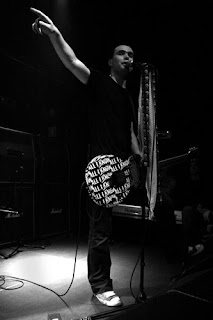
Bandpicture by Stijn Willekens. B/w picture Ward by Dieter De Volder @ De Kreun, Kortrijk.

13.4.08

So really.. how far down is down?

This is part two of the interview with Bjorn Rise And Fall. See the previous post for part one. This one is about his band and some more random stuff.

Do you have a job outside of Rise And Fall?

"I’m currently unemployed. I haven’t worked in a year actually. But I’m looking for a job."

Did you stop working because of the band?

"Yes. I stopped working a year ago, because everyone in the band wanted to grab the opportunity to tour as much as possible and do things with the band we all wanted to do for some time. If you get so many opportunities to tour, you know that it will be impossible to be out there for four months without your boss kicking you out. So everyone decided to stop working at a certain stage and tour relentlessly for 6 or 7 months. After summer we weren't very active though. The other members have picked up their jobs again. I haven’t, but now I will."

How was it like to stop working and spend so much time with the band?

"It felt pretty good. The band has been around for 5 years now. After a couple of years, you notice things are becoming better and better. You like what you do and so you put huge amounts of energy and time in it. It’s your big passion in life, you know. And you know you can get more out of it, but you have to put so much of time in your job, instead of doing what you really want to do, which is quite frustrating. If you get the chance to say “fuck it, let’s do this”, then all of a sudden you have all this freedom to do with your time what you want to do."

But sure there’s certain obligations attached to that?

"Yes. We never turn down a show. If the band is your priority, and your not contrived by a job, it’s also easier to accept all the offers you get. If someone wants to tour with you, you don’t have to stress about it. That’s cool. If it was up to me we would have never stopped doing that. After the summer we could have written new material fulltime, but due to circumstances we weren’t able to do so. The fact that we spent six months doing nothing but the band-thing and being on the road constantly for three or four months also took it’s toll. We had to become familiar with being around each other so much and sometimes we got on each others’ nerves. No big deal though. I just think everyone was kind of tired of it after the summer. We also had to look for a new rehearsal room and I spent some time in the hospital. Those things have held us back on writing new material, but now everything is coming back together again. We have a new rehearsalplace, so we can start writing new songs. And after that we can start the usual schedule again: recording and touring."

Is there a certain feeling of responsibility towards the kids that's part of playing in a bigger hardcoreband?

"I try not to be too self-conscious about that. I know how I looked at the people that were on stage when I was younger. It was with a certain respect, and not of adoration. Well, most of the time at least. I never thought I would once be the guy on stage, so I’m having a hard time imagining that I can be for the kids now what those people were to me."

"I wouldn’t do or not do, say or not say certain things because of what people might think of it. Also because I want to be seen as someone that is completely himself, and no-one else. I don’t want to say things that I don’t fully believe myself. I don’t want to say things to appear funnier or tougher. I try not to put on a mask. But eventually, when you’re on stage, there is some sort of responsibility that makes you think twice about what you do."

What kind of message do you try to put in your own lyrics?

"I think other people are more likely to find some sort of message in my lyrics. I write about what occupies my mind every day. It’s some sort of therapy actually. If you don’t feel well, you can write it off. The lyrics also aren’t really about me alone, but about me in the context of this world, society and certain issues. But I don’t think the meaning of my lyrics is very clear most of the time. There are certain things in which I believe, and those are reflected in them, but it’s not too obvious. My own experience and ideals are in it, but mostly under the surface. So anyone can get out of them what they want."

Not so long ago, there was a small argument on a messageboard about Vogue (the band, not the magazine). I wasn't at the show they were talking about, but I heard they were kind of violent and there was some damage, which in turn pissed some people off. What do you think about bands that act extremely wild and violent on stage?

"I think that’s a hard question. The danger and the energy of hardcoreshows are important. They're a part of it’s attraction too. But it has to come spontaneous. I’m not pro the “hardcore should be dangerous, so let’s break some glasses on each other’s heads”-concept. The recklessness, the spontaneous and the unpredictable make hardcore what it is."

"In the case of Vogue, I know the singer quite well, for as far as such thing is possible, and the guy is just crazy. These guys also don’t give a damn about what is expected to happen on stage. If he wants to lay down on the floor, he does. I think it’s a good thing that there’s a band out there that confronts people with the fact that hardcore is also something like that. It’s not always controllable. But of course you have to draw a line somewhere."

Isn’t there some danger involved that the band will make it ‘their thing’, their gimmick?

"I think it’s mostly the audience that makes it ‘their thing’: “Vogue is playing, let’s see if something happens,” something like that. It will probably become a part of what draws people towards the band, but I don’t think they themselves really care about that. But you cannot look into someone’s head and analyse his motivation of course."

"In the case of Bounce (singer of Vogue), I’m pretty convinced that he’s crazy. What happens on stage with him is a chemical reaction you and I cannot understand."

Back to the scene in general, and your thoughts about it. Do you think hardcore some kind of relief for people from their monotonous daily lives?

"I don’t think hardcore is unique in that aspect. Many people do things outside of what’s considered ‘normal’, like listening to unconventional music, cultmovies, theatre, mountainclimbing.. All those things are means to escape daily life and having to get up for work and coming home to tired to do anything in the evening. That’s something that draws people to hardcore, but it could be lot's of things. It’s not exclusive to hardcore."

You've been involved for quite some time now. Did the scene change a lot over the years?

"If I look at which band were active back in the days, I do think there’s more diversity now. Many bands are busy with their own thing and try to be creative in pushing the boundaries of what’s possible or not in the genre. The downside is that the whole concept got somewhat blurry. If you talked about the hardcorescene back in tha days, they knew exactly what you were talking about. Over the years it has grown so exponentially it became very fragmented. You have all these different subscenes and subgenres that have less and less in comon with eachother, I don’t like that."

Don’t you think this diversity could be a plus as well?

"It would be an enrichement.. if it still was part of this greater whole. The problem is that the meaning of hardcore/punk got somewhat lost along the way. Many people involved now have no clue about where it came from, its history, the bands that paved the roads.. The less contact with the source, the more difficult it is to recognize certain things as hardcore. It’s still important to have a direct link between what you’re doing now en what happened early ‘80ies. You have to be aware of that history. Someone who doesn’t have clue, but considers himself involved with hardcore could be compared to a Christian that never read the bible, so to speak."

3.4.08

"If it lacks feeling, it's worthless to me"

Although you’ll rarely find me in the pit, punching random people or crowdsurfing, I too feel like a real hardcorekid. So when asked to pick a topic for my paper, I decided to try and write something about this music-centered community I –despite all cynism – hold close to my heart. Having all these vague ideas in my head, but not really knowing where to start, I decided to interview some people I thought were/are important to the scene and ask them for their personal experiences, hoping to be able to give this undecipherable feeling that accompanies the whole thing a name.

One of those people is Bjorn Dossche (27), whom most of you probably know as the singer for Belgium’s underground pride Rise And Fall. I hadn’t ever talked to him before and thus didn’t quite know what to expect when meeting him at De Vooruit in Ghent, but luckily, he turned out to be this really nice and easy-going guy, making this interview one of the most personal and casual ones in the heap. This is the first part of a rather long interview. Other parts will follow as soon as I find some time to transcribe and translate them.

Bjorn: “Back when I was twelve, I was into this whole metal-thing. With the small amount of money I had, I bought cassettes and CDs. CDs were just coming up back then. I also bought music magazines, and once I read this review for a Sick Of It All album. I completely dug what was written, the album got a good score and I bought it blindly. It had a huge impact. For me, that was the starting point to get to know other bands that were linked to SIOA and other big names from that time, like Biohazard and Life Of Agony."

"After a while, you start discovering all these smaller undergroundbands. When I was 14-15 years old I started going to shows. Once you discover those a new world reveals itself in front of you. Congress was my first show. Listening to an American band on CD is one thing, but discovering that there’s a network of people that share a more or less common view and that are working on the same thing in your own neighborhood is just ‘wow’.”

What impression did that first show leave?

“It was pretty mind-blowing. You read about these things, but you never imagine that they actually happen in small basements, with 150 attendees, of which 50 are going completely crazy. There’s loads of energy, positive vibes.

Also, these people actually had something to say on stage, they were representing something. You got the feeling you found something that was yours. To me, the connection between the audience and the band is important too. It’s a whole.”

What does the scene mean to you?

“I look at the hardcorescene as a forum for creativity. Everyone can pick up an instrument and start making music, and if you can’t play by the rules, it doesn’t matter. The most important thing is that you can write a song that touches and that you take a stand as a band. In hardcore it has never been necessary to be supertalented or have the finest equipment. You just had to make the best of it. It's an attitude I can relate to very much.”

Is it really still that way nowadays? People seem to expect more and more.

“Time never stops, and so recording technology and such constantly improves, but I think the basic principles have remained intact. Hardcore has been around for 25 years, so I think it’s normal for people to expect something more nowadays. The basic idea should remain untouched, though. I still think it’s cool that everyone can take the stage and just give himself entirely. That’s also the charming thing about it. If I see a band with young kids, and they’re not really good, but they just go for it all the way, that’s so much cooler than a band of professional musicians with towers of equipment, who are much older but still haven’t understood jack shit of it all, and who stand there with an attitude like “hey, you’ve got to respect us because we’re older.”
If it lacks feeling, it’s worthless to me.”

How would you explain to someone that has no clue at all what this whole 'scene' thing is?

“A bunch of lunatics.” (laughs)
No, I don’t know. I just wouldn’t I guess. It’s something you have to experience. To explain the whole concept to someone is impossible I guess. But a quick, ten-minute description will not get you any further either. You’d just have bring that person to a show. Experiencing it is the most important thing. And talking with people involved. That way, I think he’ll get a better image of those people. You can talk about it for hours, but eventually it’s the participation that makes the scene what it is. It’s not science or something.”

Which bands have been of great influence to you?

“In the beginning I would say SOIA, and Life Of Agony. When I got to know the smaller bands, also Strife. It was the first band I knew that was talking so openly about straightedge. I digged it a lot. Also Undertow and Unbroken.”

And nowadays?

“I always keep the bands with which I grew up in high regard. But from the ‘newer’ bands, I would say Blacklisted is one of my favorites. Justice, Rhythm To The Madness, Cold World, World Collapse.. lot’s of different things.”

How did those early bands influence you on a personal level?

"Once I started going more to shows and started to understand how everything worked, I began to realize that hardcore was some kind of free and open forum for certain ideas and ideals. Some people were more direct and confronting about that, like Earth Crisis. But it left an impression. There were lots of bands that al stood for something else and that weren’t afraid to be extreme or militant about that. I liked that. In the end, when you’re 15-16 years old and you’re still searching for yourself, a good idea for someone else is almost automatically a good idea for you. When you get older, you start seeing things in a more subtle way. But take Strife and their straightedge message for example: I could completely relate to what they had to say about it. “This is also my life,” I thought.”